Bootcamp Graduate Resume: How to Compete with CS Degree Holders
Bootcamp credibility signal
3 deployed projects = proof
Bootcamp grads can't compete on credentials. You compete on shipping speed and portfolio depth. Three live projects outweigh a four-year degree for many roles.
The bootcamp stigma is real
Bootcamp graduates face a credibility gap. You spent 12-16 weeks learning to code. Traditional CS grads spent four years. Recruiters notice.
But here's what they also notice: working software.
You likely shipped more real projects in 3 months than most CS students do in 4 years of theory-heavy coursework. Your resume needs to prove that.
What bootcamp grads get wrong
Most bootcamp resumes look like this:
Education: Full Stack Web Development Bootcamp, General Assembly | Completed 2025
Skills: JavaScript, React, Node.js, Express, MongoDB, PostgreSQL, HTML, CSS, Git, GitHub, Agile, REST APIs, Redux, Webpack...
This screams "I just learned all this last month." Where's the proof you can actually use these tools? Where are the projects? Where's the deployed work?
Portfolio-first resume structure
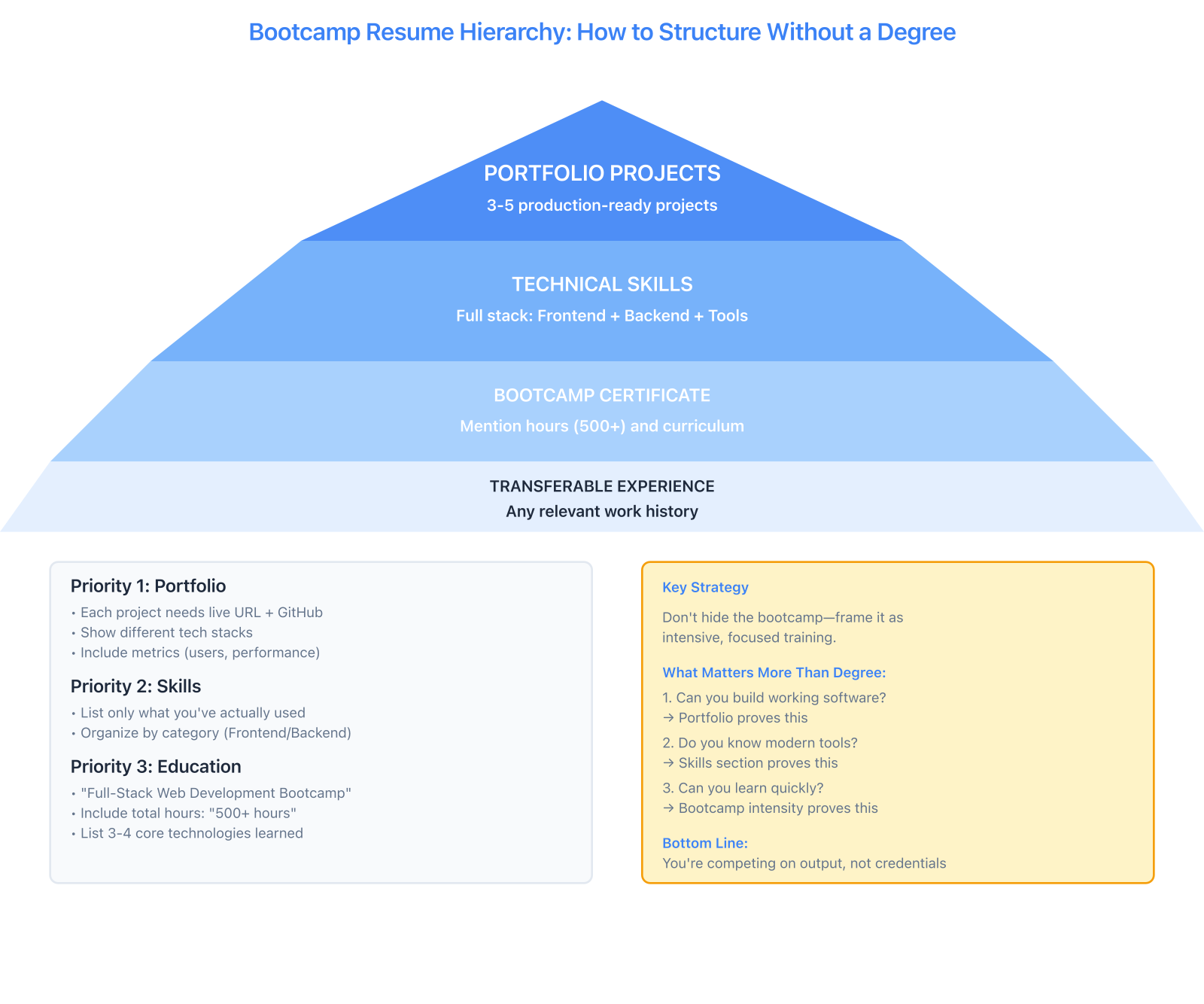
The inverted hierarchy for bootcamp grads: lead with what you can build, not where you studied. Your portfolio proves capability better than any certificate.
Flip the traditional resume hierarchy. For bootcamp graduates: lead with projects, then technical skills, then bootcamp education, then any relevant previous work experience.
Proof before credentials. By the time a recruiter reaches your education section, they've already seen you can build real applications.
How to present bootcamp projects
Your capstone project and major bootcamp assignments aren't practice exercises — they're your professional portfolio. Present them as such.
Capstone project example
Instead of:
Final Project: Built e-commerce website
Write:
StyleHub - Fashion E-Commerce Platform
December 2025 | Live: stylehub-demo.herokuapp.com
• Engineered full-stack marketplace with React/TypeScript frontend and Node.js/Express backend supporting user authentication, product catalog, and Stripe payment integration
• Designed PostgreSQL database schema with 8 normalized tables; implemented complex queries for filtering by size, color, and price range
• Deployed on AWS EC2 with automated CI/CD via GitHub Actions; achieved 1.2s average page load time
• Collaborated in 4-person Agile team using Jira for sprint planning and Git for version control

Tech Stack: React, TypeScript, Node.js, Express, PostgreSQL, AWS, Stripe API, Redux, Jest
This presentation includes:
- Live URL (proves it's real and deployed)
- Technical depth (specific implementations, not just buzzwords)
- Scale indicators (number of tables, performance metrics)
- Professional workflow (Agile, CI/CD, team collaboration)
- Full tech stack (ATS keyword optimization)
Solo projects matter more
Bootcamp group projects are valuable, but recruiters know you didn't build everything yourself. Solo projects prove independent capability.
After your bootcamp, build 1-2 additional projects alone:
WeatherNow - Real-Time Weather Dashboard
January 2026 | Live: github.com/username/weather-app
• Developed responsive weather app using React Hooks and Context API; integrates OpenWeatherMap and Geolocation APIs for automatic city detection
• Implemented dark mode toggle with localStorage persistence and custom CSS animations for weather transitions
• Achieved 98 Lighthouse performance score through lazy loading and code splitting; optimized bundle size to under 150KB
• Deployed to Vercel with automatic deployments on push; averages 200+ weekly visitors

Tech Stack: React, JavaScript, REST APIs, CSS3, Vercel
Solo projects show:
- You can start and finish independently
- You're continuing to build post-bootcamp (signals commitment)
- You understand the full development lifecycle
The 3-project minimum for bootcamps
Bootcamp grads should have at least three strong projects on their resume:
- Bootcamp capstone (most complex, team-based)
- Mid-bootcamp project (individual or pair work)
- Post-bootcamp solo build (proves continued learning)
If you only have bootcamp projects, you look like you stopped learning after graduation. Adding one post-bootcamp project signals ongoing development and self-motivation.
Skills section strategy
Bootcamps teach 20+ technologies. Listing all of them makes you look scattered.
Instead of listing everything:
HTML, CSS, JavaScript, React, Redux, Vue, Angular, Node.js, Express, Python, Django, Ruby, Rails, SQL, PostgreSQL, MongoDB, Git, GitHub, REST APIs, GraphQL, AWS, Heroku, Docker, Jest, Mocha...
Group by proficiency and relevance:
Languages: JavaScript (ES6+), TypeScript, Python, SQL
Frontend: React, Redux, HTML5, CSS3, Tailwind CSS
Backend: Node.js, Express, RESTful APIs
Databases: PostgreSQL, MongoDB
Tools: Git, Docker, AWS, Heroku, Jest, Webpack
This shows focus and organization. Pick 3-5 core technologies you're genuinely comfortable with and emphasize those.
Addressing the education gap
You can't hide that you don't have a CS degree. Don't try. Present your bootcamp education confidently:
Full Stack Web Development Intensive
App Academy, San Francisco | Completed December 2025
1000+ hours of software development training focused on JavaScript, React, Node.js, and PostgreSQL
Curriculum: Data structures, algorithms, database design, system architecture, test-driven development

Projects: 3 full-stack applications including solo capstone deployed to production
Key elements:
- "Intensive" or specific program name (signals rigor)
- Hour commitment (1000+ hours = serious training)
- CS fundamentals covered (data structures, algorithms — narrows the degree gap)
- Outcome focus (projects deployed, not just learned)
When previous experience helps
If you're career-changing into tech, your previous work experience can be an asset — but only if presented strategically.
Transferable skills that matter:
- Project management → Shows you can scope and deliver work
- Client communication → Translates to stakeholder management
- Data analysis → Bridges to technical work
- Teaching/training → Demonstrates explaining complex concepts
- Sales/marketing → Useful for product or growth-focused roles
How to present previous work:
Marketing Manager
TechCorp, Austin, TX | 2022 - 2025
• Managed $500K annual digital marketing budget; analyzed campaign performance using Google Analytics and SQL queries
• Automated reporting workflows with Python scripts, reducing manual work by 15 hours/month
• Collaborated with engineering team to implement web analytics tracking and A/B testing infrastructure
Notice the emphasis on technical intersections: SQL, Python, engineering collaboration. This positions your previous career as complementary, not irrelevant.
Resume templates for bootcamp grads
Use Modern template
Modern template works well for bootcamp grads because:
- Two-column layout lets you feature projects prominently
- Supports technical density without feeling cramped
- Contemporary design signals you understand modern web aesthetics
- Balances technical content with readability
Avoid Minimal initially
While Minimal template is ATS-friendly, it's better for candidates with traditional credentials (strong education, established companies). Bootcamp grads benefit from the visual interest of Modern, which helps your projects stand out.
Skip Creative and Elegant
Save these for when you have 2-3 years of professional experience. Early-career candidates using overly designed templates can come across as trying to compensate for thin experience.
The GitHub strategy
Your GitHub profile is your extended resume. For bootcamp grads, it's proof your projects are real.
GitHub must-haves:
- Professional README files for each project with:
- Clear description of what the app does
- Tech stack listed upfront
- Setup instructions
- Screenshots or GIFs
- Live deployment link
- Consistent commit history (shows ongoing work, not one-time pushes)
- Clean, organized repos (no "test-project-123" clutter)
- Pinned repos featuring your 3 best projects
Add your GitHub URL prominently on your resume:
John Smith
[email protected] | 555-123-4567 | San Francisco, CA
github.com/johnsmith | linkedin.com/in/johnsmith | johnsmith.dev
Recruiters will check your GitHub. Make sure it reinforces your resume, not contradicts it.
ATS considerations for bootcamp resumes
Bootcamp grads often get filtered by ATS systems because their resumes lack traditional education credentials. Compensate with strong keyword optimization.
Pull keywords from job descriptions
If the job posting says:
"Looking for developers with experience in React, Node.js, PostgreSQL, and RESTful API design..."
Your resume should include those exact terms in project descriptions:
• Built RESTful API using Node.js and Express with PostgreSQL database
• Implemented React frontend with Redux for state management
This isn't keyword stuffing — it's using industry-standard terminology to describe your actual work.
Test your resume with ATS Checker
Before applying, run your resume through our ATS Checker to ensure:
- Your projects are being parsed correctly
- Technical skills are recognized
- Section headers are detected properly
- No formatting issues block parsing
Upload a PDF version and paste the job description you're targeting. The tool will show you exactly where to strengthen keyword matches.
Common bootcamp resume mistakes
Listing bootcamp projects only
If all your projects are from the bootcamp curriculum, you look like you stopped building after graduation. Add at least one post-bootcamp personal project to show continued growth.
Using weak action verbs
"Learned React" or "Worked with databases" sounds like student work.
Use production-level verbs: "Engineered," "Architected," "Deployed," "Optimized," "Scaled."
Hiding the timeline
Don't omit dates trying to hide that you're recently trained. "Completed December 2025" with a January 2026 solo project shows velocity, not inexperience.
Overselling complexity
Don't describe your bootcamp capstone as "enterprise-grade financial platform serving millions." Be honest about scope while emphasizing technical quality:
"Personal finance tracker with JWT authentication, RESTful API, and responsive React interface; supports transaction categorization and budget tracking."
Ignoring non-technical contributions
If you helped plan sprint retrospectives, wrote documentation, or mentored junior bootcamp cohort members, include it. These show professional maturity beyond pure coding.
The bootcamp advantage
Here's what bootcamp grads have that many CS grads don't:
- Practical, modern tech stacks (React, Node, AWS — not Java Swing from 2010)
- Full-stack capability (most CS programs specialize; bootcamps force breadth)
- Shipping velocity (you're trained to build quickly)
- Real deployment experience (not just localhost)
- Career-change motivation (you chose this path deliberately)
Your resume should emphasize these strengths through:
- Live, deployed projects (not just GitHub repos)
- Modern tech stack (listed prominently)
- Production-ready code (tested, documented, deployed)
- Career narrative (if applicable: "Transitioned from marketing to software development...")
Getting started
Build your bootcamp resume in three phases:
Phase 1: Immediately post-bootcamp
Create a resume with:
- 2-3 bootcamp projects (including capstone)
- Skills section with 8-10 core technologies
- Bootcamp education
- Previous work if relevant
Use this for initial applications. You'll get some interviews based on bootcamp projects alone.
Phase 2: First month post-graduation
Add:
- 1 solo project built independently
- Contributions to open source (even small ones)
- Updated GitHub with polished READMEs
This strengthens your "continued learning" signal significantly.
Phase 3: 2-3 months post-graduation
Ideally, you've landed your first role by now. If you're still searching:
- Add a second solo project (different tech stack)
- Contribute to a larger open source project
- Consider freelance or contract work (even small gigs)
The goal is demonstrating ongoing development beyond bootcamp training.
Start building your bootcamp resume
Bootcamp graduates can compete with CS degree holders — but only if your resume leads with deployed projects and technical proof.
Use our resume builder to create a project-focused layout with the Modern template. Structure your resume to showcase working software first, credentials second.
For more guidance on presenting projects effectively, see our entry-level resume guide. If you're still deciding whether to highlight previous career experience, read our career transition resume guide.
Your bootcamp training gave you the skills. Now give yourself the resume that proves it.
Want a resume that reads like this article?
Open the builder and polish your resume with a live A4 preview.