CV vs Resume: What’s the Difference and When to Use Each
Terminology confusion
CV vs Resume
In the US, a resume is the standard job document. In most of Europe, employers use the term CV for the same purpose.
Many job seekers use the terms CV and resume interchangeably. In practice, they are not the same document.
The difference depends heavily on region, industry, and purpose. In the United States, a resume is the standard job application document. In most of Europe, employers expect a CV instead.
Understanding when to use each can prevent confusion and improve your chances of passing the initial screening.
Before you start writing, it helps to structure your document correctly. Tools like the resume builder help create a clean format that recruiters and ATS systems can scan easily.
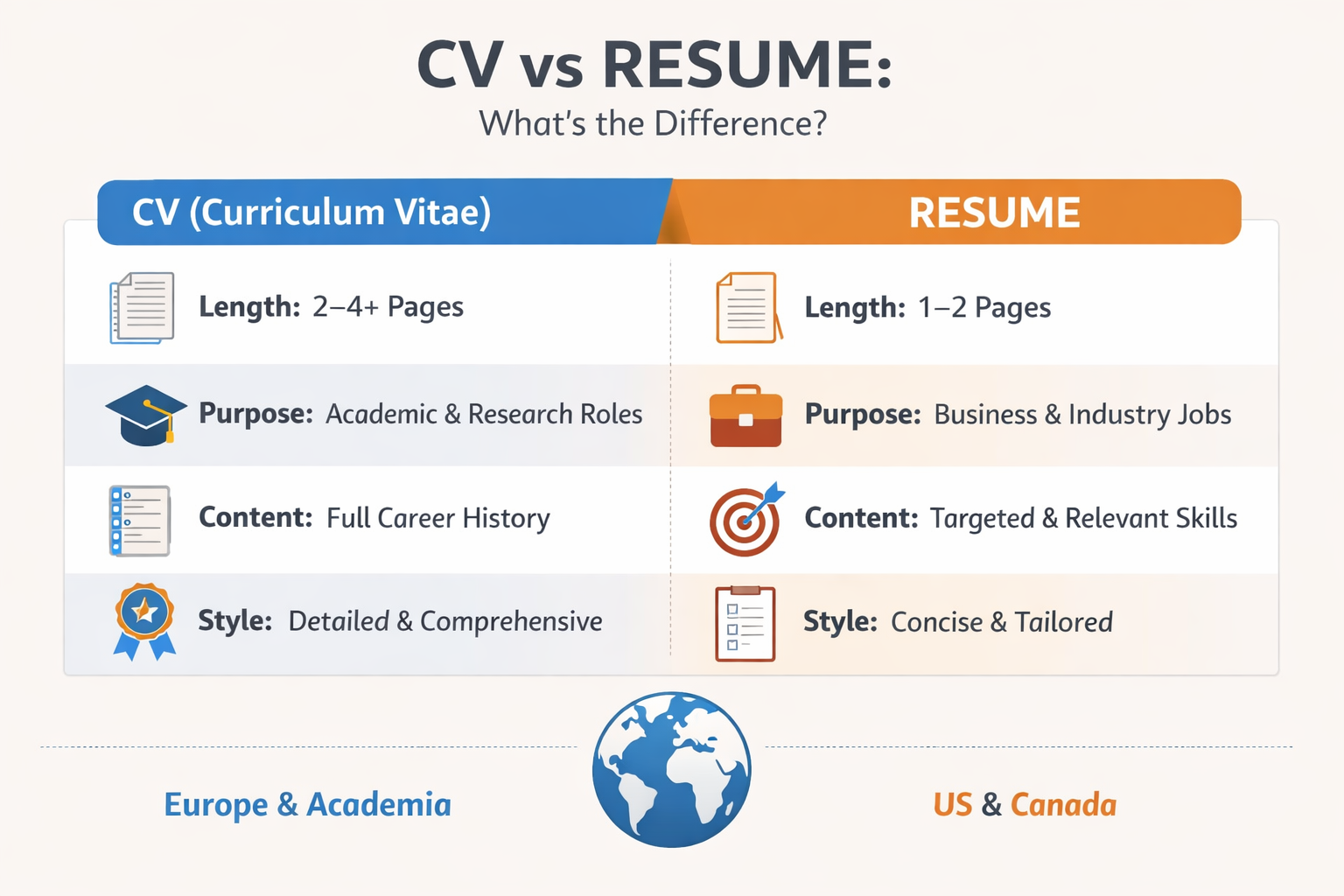
CVs are typically longer and more detailed. Resumes are shorter and tailored to a specific role.
The short answer
A resume is a short, targeted summary of your experience designed for a specific job.
A CV (Curriculum Vitae) is a more comprehensive record of your academic and professional history.
The differences become clearer when you compare their structure and purpose.
CV vs Resume: Key differences
| Factor | Resume | CV |
|---|---|---|
| Length | 1–2 pages | Often 2–4+ pages |
| Focus | Relevant experience | Complete professional history |
| Usage | Industry jobs | Academic, research, education |
| Customization | Tailored per job | Usually static |
| Common regions | US, Canada | Europe, UK, academia worldwide |
The biggest difference is focus. A resume highlights what matters for one job. A CV documents your full career path.
Quick summary
- Resume → short, targeted, 1–2 pages
- CV → detailed career history, often longer
What a resume usually includes
A strong resume focuses on impact and relevance. Most recruiters expect these sections:
- Contact information
- Professional summary
- Work experience
- Skills
- Education
- Optional projects or certifications
Each role should highlight outcomes, not responsibilities.
For example:
Weak
"Responsible for maintaining backend services."
Strong
"Reduced API latency by 35% by optimizing database queries and caching."
Clear outcomes help recruiters understand your contribution quickly.
For deeper guidance, see Top Resume Mistakes That Kill Your Chances.
What a CV usually includes
A CV is more detailed and often used in academic or research environments.
Typical CV sections include:
- Contact information
- Research interests
- Education
- Teaching experience
- Publications
- Conferences and presentations
- Grants or funding
- Professional affiliations
- Awards
Unlike resumes, CVs are not aggressively shortened. The goal is completeness and credibility, not brevity.
Regional differences
The meaning of CV vs resume changes depending on geography.
United States and Canada
In North America:
- Resume = standard job application document
- CV = used primarily in academia and research
Most companies expect a 1–2 page resume, even for experienced professionals.
Europe
In Europe, the word CV often refers to what Americans call a resume.
A typical European CV still includes:
- Work experience
- Skills
- Education
- Languages
But the document is usually slightly longer and more chronological.
United Kingdom
The UK mainly uses the term CV, even for standard professional roles.
Despite the name, the structure resembles a resume more than an academic CV.
Academic CV vs industry resume
The academic job market uses a completely different format.
Academic CVs emphasize:
- Publications
- Teaching experience
- Research grants
- Conference talks
- Academic affiliations
Industry resumes emphasize:
- Business outcomes
- Delivered projects
- Technical or professional skills
- Leadership impact
Using the wrong format can signal that a candidate does not understand the hiring context.
When you should use a resume
Use a resume when applying to:
- Technology companies
- Startups
- Corporate roles
- Consulting firms
- Marketing or product roles
- Most private-sector jobs
These employers prioritize concise evidence of results.
For example, a software engineer resume should show:
- systems built
- performance improvements
- scale or reliability metrics
When you should use a CV
Use a CV when applying to:
- Universities
- Research institutes
- PhD programs
- Academic fellowships
- Scientific roles
These employers evaluate research history and academic credibility, not just work outcomes.
Common mistakes job seekers make
Using a 5-page CV for industry jobs.
Recruiters expect a concise resume. Long documents reduce readability.
Submitting a resume to academic roles.
Universities expect detailed CVs with publications and research history.
Confusing terminology across regions.
A “CV” in Europe may mean something different from a “CV” in the US.
Listing responsibilities instead of results.
Regardless of format, impact still matters.
Resume vs CV length
Length depends on experience and context.
Typical resume length
- Entry level: 1 page
- Mid-level: 1–2 pages
- Senior roles: 2 pages
Typical CV length
- Early academic career: 2–3 pages
- Senior researchers: 5+ pages
If you're applying outside academia, shorter is usually better. See One Page vs Two Page Resume: When Length Matters.
Do recruiters care about the terminology?
Usually, structure matters more than the name.
Recruiters care about:
- clarity
- relevance
- outcomes
- readable formatting
Whether the file is labeled "CV" or "resume" rarely determines the outcome. What matters is how quickly they can understand your value.
FAQ
Is a CV better than a resume?
Neither is better. They serve different purposes. A resume works best for industry jobs, while CVs are used in academia.
Can a resume be two pages?
Yes. Experienced professionals often need two pages to present relevant achievements.
Should I tailor my resume for every job?
Yes. Adjust keywords and highlight the experience most relevant to the role.
Do European companies prefer CVs?
Yes. Most European employers use the term CV, but the structure is similar to a resume.
Can I convert my CV into a resume?
Yes. Focus on recent roles, remove older details, and highlight measurable outcomes.
What actually matters
The CV vs resume debate often distracts from what recruiters actually evaluate.
Hiring decisions rarely depend on the label. They depend on clarity, relevance, and evidence of impact.
Whether you call it a CV or a resume, the goal is the same: make it easy for a recruiter to understand what you did, what changed because of your work, and why you are relevant to the role.
If you want a clean, structured document that works across regions and ATS systems, you can build one with the resume builder.
Want a resume that reads like this article?
Open the builder and polish your resume with a live A4 preview.