Your First Resume Ever: The Complete Guide for Absolute Beginners
First resume benchmark
1 strong project > 10 listed skills
Your first resume doesn't need years of experience. It needs one solid example that proves you can deliver real work.
Starting from absolute zero
You've never had a real job. No internships. No freelance gigs. Maybe not even a completed project yet. But you need a resume.
This is the true starting point for most students — and it's more common than you think. The challenge isn't that you have nothing to show. It's that you haven't learned how to translate what you've done into resume-worthy content.
This guide covers exactly that: how to build your first resume when your work history section is genuinely empty.
What belongs on a first resume
Your first resume won't look like experienced candidates' resumes. That's fine. You're not competing with them yet.
A first resume has three core sections:
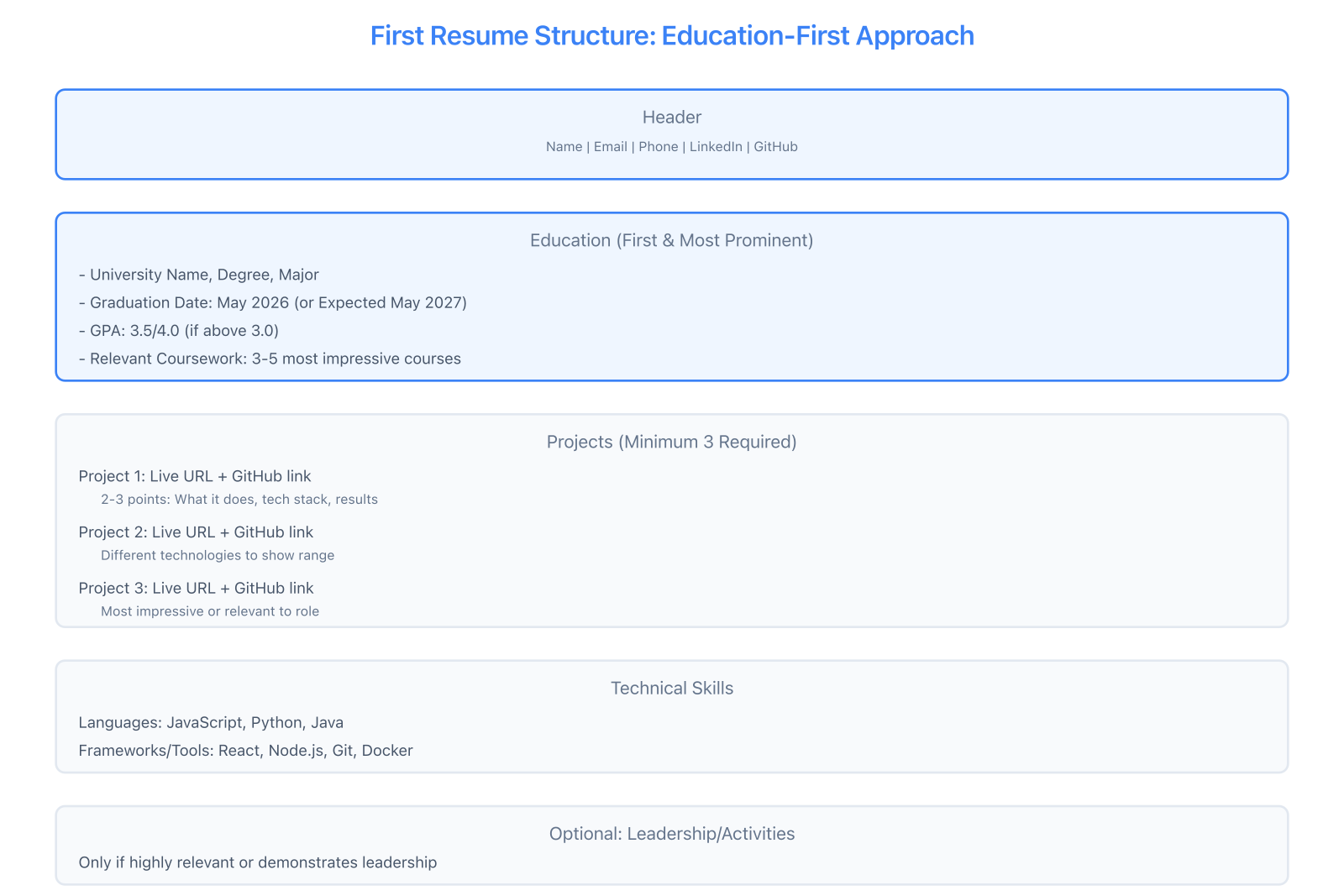
Education-first structure for students with limited work history. This hierarchy makes sense when your degree is your strongest credential.
Education (your primary credential)
This section leads because it's your strongest signal right now. Include:
- Degree and major (even if in-progress)
- Expected graduation date (May 2026, not just "2026")
- GPA if above 3.0 (otherwise skip it)
- Relevant coursework (3-5 classes that connect to target roles)
- Academic honors (Dean's List, scholarships, department awards)
Format it clearly:
Bachelor of Science in Computer Science
University of California, Berkeley
Expected May 2026 | GPA: 3.6

Relevant Coursework: Data Structures, Web Development,
Database Systems, Software Engineering, Machine Learning
If you're a bootcamp graduate, follow similar logic:
Full Stack Web Development Certificate
General Assembly, San Francisco
Completed December 2025

Focus: JavaScript, React, Node.js, PostgreSQL, REST APIs
Your education section proves you've learned the fundamentals. That's valuable.
Projects (your proof of capability)
This is where you demonstrate you can apply what you've learned. Even if these are academic or self-directed projects, present them as real work.
What counts as a project for your first resume:
- Class projects with complexity (not homework exercises)
- Personal projects you built independently
- Hackathon submissions (even if you didn't win)
- Open source contributions (documentation, bug fixes, features)
- Capstone or thesis work
How to present a project:
E-Commerce Platform (Personal Project)
December 2025
• Built full-stack web app with React, Node.js, and MongoDB
  supporting 50+ products with cart and checkout functionality
• Implemented user authentication using JWT and bcrypt for
  secure password storage
• Deployed to Heroku with CI/CD pipeline; achieved 95+
  Lighthouse performance score
What makes this work? The project name tells them what you built. The date shows it's recent work. Action verbs ("Built," "Implemented," "Deployed") beat passive voice every time. Specific technologies help with keyword matching. And metrics — even technical ones like performance scores — prove you care about outcomes.
Even without users or real-world impact, you can describe technical achievements: database design, API architecture, deployment complexity.
Skills (what you can work with)
Only list what you've actually used. Seriously. Recruiters can tell when you've padded your skills list with things you touched once in a tutorial.
Group by category:
Technical Skills: JavaScript, Python, React, Node.js, SQL, Git
Design Tools: Figma, Adobe XD, Photoshop
Languages: English (native), Spanish (conversational)
Don't list "Microsoft Office" unless the job specifically requires it. Don't list soft skills like "teamwork" or "communication" here — show them through your project descriptions instead.
What NOT to include on your first resume
Your first resume should be focused. These elements waste space or signal inexperience:
High school achievements
Once you're in college or beyond, high school accomplishments don't belong on your resume. Exception: if you're still in your first year of college and have significant achievements (national competition winner, published research), you can include them briefly.
Irrelevant work experience
That summer job at a retail store or restaurant may have taught you responsibility, but if you're applying for technical roles, it doesn't strengthen your case. Only include work experience if:
- It's in the same industry or field
- It demonstrates directly transferable skills
- You have absolutely nothing else to list (in which case, keep it brief)
Objective statements
"Seeking an entry-level position where I can grow my skills and contribute to a dynamic team."
This adds nothing. Every entry-level candidate wants to grow. Use that space for a real project or skill instead.
If you want an intro section, use a brief summary that highlights your actual capabilities:
Computer science student with experience building full-stack web applications using React and Node.js. Strong foundation in algorithms, data structures, and database design. Passionate about creating accessible, user-friendly interfaces.
But honestly, for your first resume, skip the summary entirely and lead with Education.
References available upon request
This is assumed. Don't waste a line on it.
Unprofessional email addresses
[email protected] is fine.
[email protected] is not.
If your current email is unprofessional, create a new one. It takes 2 minutes and removes an instant credibility hit.
The coursework strategy
When work experience is missing, relevant coursework becomes more important — but only if you present it strategically.
Which courses to list
Include 3-5 courses that:
- Connect directly to the role you're applying for (Database Systems for backend roles, UI/UX Design for frontend/design roles)
- Involved substantial projects or practical work
- Signal advanced or specialized knowledge (not Intro to Programming)
Skip general education requirements. "English Composition" and "College Algebra" don't strengthen a technical resume.
How to expand coursework into experience
If a course involved significant project work, you can extract it as a standalone project:
Instead of just listing "Mobile App Development" under coursework, expand it:
iOS Weather App (Mobile App Development Course)
September - December 2025
• Developed native iOS app in Swift with real-time weather
  data from OpenWeatherMap API
• Implemented CoreLocation for automatic city detection and
  SwiftUI for responsive interface
• Published to TestFlight for beta testing with 15 classmates;
  iterated on feedback
This transforms a class assignment into proof of capability.
The extracurricular advantage
If projects are thin, extracurriculars can demonstrate leadership, initiative, and transferable skills.
What counts:
- Student organization leadership (president, treasurer, event coordinator)
- Volunteer work that involved real responsibility
- Club projects (robotics club, design collective, startup incubator)
- Teaching or tutoring (shows mastery and communication skills)
- Published writing (blog, student newspaper, research papers)
Present these like work experience:
Vice President, Web Development Club
September 2024 - Present
• Lead weekly workshops teaching HTML/CSS/JavaScript to 30+ members
• Organized hackathon attracting 100+ participants; secured $5K in sponsorships
• Maintain club website using Gatsby and host on Netlify; averages 500 monthly visitors
This shows leadership, technical skills, and real outcomes — all valuable to employers.
Template strategy for first resumes
The right template depends on what you're highlighting.
Use Minimal template when:
- Your education is strong (top school, high GPA, competitive program)
- You're applying to traditional industries (finance, consulting, healthcare)
- You need maximum ATS compatibility
- You have limited content and want clean, uncluttered spacing
Minimal template puts education at the top and uses a single-column layout that's easy for ATS systems to parse.
Use Modern template when:
- You have 2-3 solid projects to showcase
- You're applying to tech or creative roles
- You want a contemporary look that shows design awareness
- You have enough content to fill a two-column layout
Modern template lets you feature projects prominently while maintaining professionalism.
Avoid Creative or Elegant for first resumes
These templates shine when you have substantial experience and want to stand out visually. For your first resume, prioritize clarity and content over design.
The 3-project minimum
Before you start applying, aim for three demonstrable projects. They don't all need to be large, but they should show:
- Technical breadth (different technologies or problem domains)
- Completion (shipped, deployed, or fully functional)
- Real-world application (solves an actual problem, even if small)
Example project portfolio for a first resume:
- Personal website/portfolio (shows you can ship something public)
- Academic capstone project (demonstrates depth and collaboration)
- Open source contribution (proves you can work with existing codebases)
Three projects give you enough content to fill a resume and enough proof to get interviews.
Common first resume mistakes
Listing every technology you've touched
Saying you know 20 programming languages signals you're still learning, not proficient. List 3-5 core technologies you could confidently use in a job today.
Using passive language
"Was responsible for..." or "Helped with..." sounds weak.
Use active verbs: "Built," "Developed," "Designed," "Implemented," "Deployed."
Hiding in-progress education
Don't leave graduation dates off because you haven't finished yet. "Expected May 2026" shows you're actively completing your degree. Missing dates make recruiters wonder if you dropped out.
Inflating project complexity
Don't describe a command-line calculator as "enterprise-grade financial software." Recruiters can tell. Be honest about scope while still presenting the technical work clearly.
Ignoring the ATS
Even your first resume needs to pass ATS systems. Use clean formatting, standard section headers, and include relevant keywords from job descriptions naturally in your project descriptions.
Our ATS Checker lets you upload your resume and see exactly how well it parses. Use it before applying to ensure your first resume doesn't get filtered out.
Getting started with your first resume
You don't need years of experience to build a credible resume. You need:
- Clear education credentials
- 2-3 solid projects that prove capability
- Clean, ATS-friendly formatting
- Honest presentation of what you've actually built
Start with our resume builder, choose the Minimal or Modern template, and focus on presenting your academic work and projects as professional proof. Your first resume won't be your last — it just needs to be good enough to get that first interview.
For more specific guidance on building out project descriptions, see our entry-level resume guide. If you're coming from a bootcamp background, check out our tips on showcasing bootcamp projects effectively.
Want a resume that reads like this article?
Open the builder and polish your resume with a live A4 preview.