ATS Filtering Rates by Industry: Where Your Resume Goes to Die
Tech industry ATS barrier
97% automated filtering
Almost every tech company uses ATS. Your resume must pass algorithmic screening before any human sees it. Parse correctly or get filtered out with 75% of other applications.
Why industry matters for ATS success
Not all industries screen resumes the same way. A resume that works for creative agencies might fail instantly at financial firms. A format that passes tech company ATS could get rejected by healthcare systems.
This guide breaks down ATS adoption, filtering patterns, and optimization strategies by industry using data from major ATS vendors, recruiting platforms, and application tracking research.
Understanding industry-specific ATS patterns is the difference between getting filtered out at 75% of applications or consistently reaching human review.
ATS adoption by industry
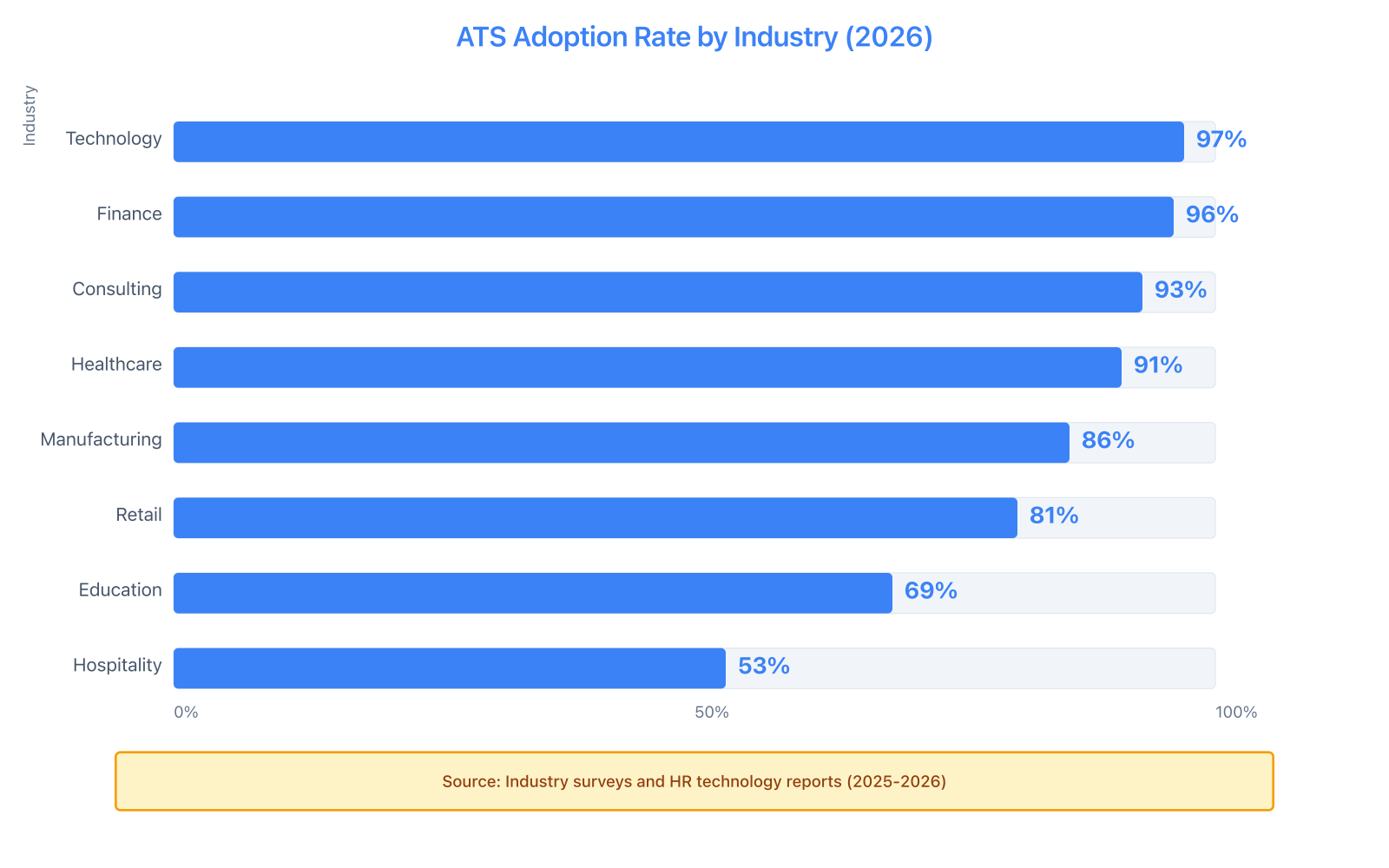
ATS adoption rates vary from 97% in technology to 42% in non-profits. Your resume strategy should match the industry's automation level—tech roles demand strict ATS optimization while creative fields allow more flexibility.
Industries with highest ATS usage
Technology: 97%
- Companies: Google, Microsoft, Amazon, Meta, Salesforce, Adobe, Stripe, Airbnb
- Common ATS: Greenhouse (46%), Lever (22%), Workday (18%), Ashby (8%)
- Avg. applications per role: 250-350
- ATS rejection rate: 78%
Tech companies face massive application volume, making ATS mandatory. They prioritize technical keyword matching (programming languages, frameworks, tools), GitHub/portfolio link extraction, and years of experience with specific technologies. Degree requirements often get listed but not strictly enforced.
Finance & Banking: 96%
- Companies: JPMorgan, Goldman Sachs, Citi, Bank of America, Wells Fargo, Morgan Stanley
- Common ATS: Workday (62%), Taleo (24%), iCIMS (11%)
- Avg. applications per role: 150-220
- ATS rejection rate: 81%
Financial institutions use ATS heavily for compliance and record-keeping. They care about exact credential matching (CFA, CPA, MBA from target schools), industry experience keywords, regulatory compliance, and traditional formatting. Conservative design isn't just preferred — it's expected.
Consulting: 93%
- Companies: McKinsey, BCG, Bain, Deloitte, Accenture, EY, KPMG, PwC
- Common ATS: Workday (48%), SuccessFactors (28%), custom systems (24%)
- Avg. applications per role: 300-500
- ATS rejection rate: 85%
Consulting firms get enormous application volume for limited roles. ATS filters for:
- Target school attendance (often automated knockout criteria)
- Quantifiable achievements (metrics, percentages, dollar values)
- Industry-specific terminology (due diligence, stakeholder management, business case)
- Case competition or leadership experience keywords
Healthcare: 89%
- Companies: Kaiser, Mayo Clinic, UnitedHealth, CVS Health, HCA Healthcare
- Common ATS: Workday (38%), iCIMS (31%), Taleo (19%)
- Avg. applications per role: 80-140
- ATS rejection rate: 72%
Healthcare ATS focuses on credentials and compliance:
- License and certification verification (RN, MD, PA-C, etc.)
- Required credentials (ACLS, BLS certifications)
- Specific clinical experience keywords
- Compliance and HIPAA-related terminology
Industries with moderate ATS usage
Manufacturing: 81%
- Companies: Boeing, GE, 3M, Ford, Tesla, Lockheed Martin
- Common ATS: Workday (34%), Taleo (28%), SAP SuccessFactors (22%)
- Avg. applications per role: 60-120
- ATS rejection rate: 68%
Manufacturing ATS screens for:
- Safety certifications (OSHA, Six Sigma, Lean Manufacturing)
- Technical specifications and equipment keywords
- Quality control terminology
- Engineering degree verification
Retail: 74%
- Companies: Walmart, Target, Amazon Retail, Home Depot, Costco
- Common ATS: Workday (41%), iCIMS (29%), Taleo (18%)
- Avg. applications per role: 100-180
- ATS rejection rate: 64%
Retail ATS handles high-volume hiring with focus on:
- Availability and scheduling keywords
- Customer service experience
- POS system familiarity
- Management/leadership for higher roles
Industries with lower ATS usage
Hospitality: 61%
- Companies: Marriott, Hilton, Hyatt, restaurant chains
- Common ATS: Workday (35%), ADP (28%), custom/regional (37%)
- Avg. applications per role: 40-80
- ATS rejection rate: 58%
Hospitality is less ATS-dependent but still uses automation for:
- Certifications (food handler, liquor license, sommelier)
- Language skills
- Availability for shifts
- Guest-facing experience keywords
Non-profit: 52%
- Organizations: Large foundations, international NGOs, hospitals, universities
- Common ATS: iCIMS (32%), Workable (24%), BambooHR (19%), manual (25%)
- Avg. applications per role: 30-70
- ATS rejection rate: 51%
Non-profits use ATS less frequently but screen for:
- Mission alignment keywords
- Grant writing and fundraising experience
- Volunteer management terminology
- Budget management for small teams
Creative/Agency: 47%
- Companies: Ad agencies, design studios, production companies
- Common ATS: Lever (28%), Greenhouse (19%), BambooHR (16%), portfolio review (37%)
- Avg. applications per role: 50-90
- ATS rejection rate: 45%
Creative industries rely more on portfolio review but use ATS for:
- Software proficiency (Adobe Creative Suite, Figma, Sketch)
- Project types (branding, UI/UX, motion graphics)
- Client/brand name recognition
- Awards and publications
Major ATS platforms and their parsing quirks
Workday (34% market share)
Industries: Tech, finance, consulting, healthcare
Parsing strengths:
- Excellent date range extraction
- Strong contact information detection
- Handles PDF and .docx equally well
- Good with standard section headers
Parsing weaknesses:
- Struggles with creative section names
- Tables can scramble bullet order
- Text boxes often ignored
- Multi-column layouts sometimes parse left-then-right, sometimes interleaved
Optimization tips:
- Use standard headers: "Experience," "Education," "Skills"
- Single-column layout is safest
- Keep contact info at top in plain text
- Date format: "Month YYYY - Month YYYY"
Greenhouse (18% market share)
Industries: Tech (especially startups), creative, consulting
Parsing strengths:
- Best-in-class GitHub/portfolio link detection
- Excellent with modern resume designs
- Strong keyword matching algorithms
- Good section reordering tolerance
Parsing weaknesses:
- Sometimes misses education if not labeled "Education"
- Degree abbreviations can cause issues (use "Bachelor of Science" not "BS")
- Very sensitive to file corruption
Optimization tips:
- Include URLs prominently (GitHub, portfolio, LinkedIn)
- Spell out degree names fully
- Test PDF opens correctly before uploading
- Use descriptive project names (not "Project 1")
Lever (12% market share)
Industries: Tech, startups, scale-ups
Parsing strengths:
- Modern design-friendly
- Strong technical keyword extraction
- Handles international formats well
- Good with non-traditional section ordering
Parsing weaknesses:
- Can miss nested bullet points
- Sometimes struggles with dense formatting
- Phone number parsing occasionally fails with international formats
Optimization tips:
- Keep bullet hierarchy simple (avoid sub-bullets)
- Use standard US phone format or include country code clearly
- Put technical skills in dedicated section, not embedded in text
- Test with international address formats if applicable
Taleo (Oracle - 11% market share)
Industries: Large enterprises, finance, manufacturing, government
Parsing strengths:
- Reliable with traditional resume formats
- Strong compliance tracking
- Good date parsing
- Handles education credentials well
Parsing weaknesses:
- Worst performer with modern/creative designs
- Tables break parsing badly
- Icons and graphics cause failures
- Multi-column layouts often scramble completely
- Slow to update parsing technology
Optimization tips:
- Use most conservative formatting possible
- Plain text styling only
- Single column mandatory
- Avoid all graphics, icons, charts
- Traditional fonts only (Arial, Times New Roman, Calibri)
iCIMS (10% market share)
Industries: Healthcare, retail, manufacturing, government
Parsing strengths:
- Good with certifications and licenses
- Strong education parsing
- Handles acronyms well
- Reliable contact info extraction
Parsing weaknesses:
- Sometimes misses skills not in dedicated section
- Can struggle with non-US date formats
- Sensitive to font encoding issues
Optimization tips:
- Put certifications in clear section (not buried in bullets)
- Use "Skills" section prominently
- Standard date formats (avoid day/month/year)
- Use UTF-8 encoding for special characters
Industry-specific keyword strategies
Technology
Must-have keywords by role:
Software Engineer:
- Programming languages (JavaScript, Python, Java, Go, TypeScript)
- Frameworks (React, Node.js, Django, Spring, Angular)
- Tools (Git, Docker, Kubernetes, AWS, CI/CD)
- Methodologies (Agile, Scrum, TDD)
- Scale indicators (millions of users, distributed systems, microservices)
Data Scientist:
- Languages (Python, R, SQL, Scala)
- ML frameworks (TensorFlow, PyTorch, Scikit-learn)
- Big data tools (Spark, Hadoop, Airflow)
- Stats/methods (regression, classification, NLP, deep learning)
- Business impact (model accuracy improvement, revenue impact)
Product Manager:
- Frameworks (Agile, Scrum, Lean, Design Thinking)
- Tools (Jira, Figma, Analytics platforms)
- Metrics (DAU, retention, conversion, NPS)
- Skills (roadmapping, stakeholder management, user research)
- Business outcomes (launched product, grew feature to X users)
Finance
Must-have keywords by role:
Investment Banking Analyst:
- Deal types (M&A, IPO, debt financing, restructuring)
- Modeling (DCF, LBO, comparable company analysis)
- Tools (Excel, PowerPoint, Capital IQ, Bloomberg)
- Industries (healthcare, technology, energy, consumer)
- Quantifiable deals ($X billion transaction value, X deals closed)
Financial Analyst:
- Reporting (GAAP, IFRS, financial statements)
- Analysis (variance analysis, budget forecasting, financial modeling)
- Tools (Excel, SQL, Tableau, SAP, Oracle)
- Certifications (CFA Level I/II/III, CPA)
- Business impact (identified $X savings, improved accuracy by Y%)
Consulting
Must-have keywords by role:
Management Consultant:
- Services (strategy, operations, digital transformation)
- Industries (financial services, healthcare, technology, retail)
- Skills (stakeholder management, business case development, due diligence)
- Frameworks (Porter's Five Forces, BCG Matrix, SWOT)
- Outcomes (delivered $X value, improved efficiency by Y%)
IT Consultant:
- Platforms (Salesforce, SAP, Oracle, Microsoft Dynamics)
- Methodologies (Agile, Waterfall, change management)
- Technical (integration, migration, implementation, customization)
- Certifications (PMP, Salesforce Admin, AWS Solutions Architect)
- Scale (enterprise-wide rollout, X-user deployment)
Healthcare
Must-have keywords by role:
Registered Nurse:
- Specialties (ICU, ER, OR, pediatrics, oncology)
- Certifications (BLS, ACLS, PALS, specialty certifications)
- Systems (Epic, Cerner, MEDITECH)
- Skills (patient assessment, IV insertion, medication administration)
- Outcomes (patient satisfaction scores, reduced readmissions)
Healthcare Administrator:
- Compliance (HIPAA, Joint Commission, CMS regulations)
- Systems (EHR implementation, revenue cycle management)
- Operations (staff scheduling, budget management, quality improvement)
- Metrics (patient satisfaction, operational efficiency, cost reduction)
- Certifications (FACHE, CMPE, MHA)
Parsing failure rates by resume element
Elements that cause ATS failures (by frequency)
High-risk elements (30%+ failure rate):
- Graphics and images (41% failure)
- Text in headers/footers (38% failure)
- Tables for layout (37% failure)
- Columns (multi-column layout) (33% failure)
- Custom fonts with special characters (31% failure)
Medium-risk elements (15-30% failure rate):
- Icons as bullet points (28% failure)
- Text boxes (24% failure)
- Colored text (non-black) (19% failure)
- Hyperlinks without visible text (17% failure)
- Condensed or expanded font spacing (16% failure)
Low-risk elements (under 15% failure rate):
- Bold and italic formatting (3% failure)
- Bullet points (standard) (2% failure)
- PDF vs .docx (5% difference favoring PDF)
- Standard fonts (1% failure)
- One accent color in black text (4% failure)
Source: Jobscan ATS testing across 8 platforms, 2025
How to test your resume for industry-specific ATS
Before applying to tech companies:
- Upload resume to ATS Checker
- Paste job description from target company
- Verify these parse correctly:
- Programming languages in skills section
- GitHub/portfolio URLs clickable
- Project descriptions show technologies used
- Date ranges for all positions/projects
- Check keyword match score for technical terms
- Optimize missing keywords naturally in project descriptions
Before applying to finance companies:
- Use most conservative template (Minimal)
- Test with ATS Checker
- Verify these parse correctly:
- Degree name and institution
- GPA if strong (3.5+)
- Quantifiable achievements ($X managed, Y% improvement)
- Industry-specific terminology (M&A, portfolio, risk)
- Ensure all metrics are clearly formatted (not in parentheses that might not parse)
Before applying to consulting firms:
- Focus on outcomes and metrics in every bullet
- Test with ATS Checker
- Verify these parse correctly:
- School name (critical for target school filtering)
- Leadership titles and organization names
- Quantified impacts ($X value, Y% improvement, Z people managed)
- Industry keywords (strategy, operations, stakeholder)
- Ensure first bullet of each position shows impact prominently
Before applying to healthcare organizations:
- Create dedicated certifications section
- Test with ATS Checker
- Verify these parse correctly:
- License numbers and states
- Certifications with issuing bodies
- Clinical specialties
- Medical terminology and systems (Epic, Cerner)
- Spell out abbreviations first use (Registered Nurse (RN))
Industry-specific template recommendations
Tech companies → Modern template
Modern template works best for tech because:
- Two-column layout balances content density
- Supports project showcase prominently
- Modern typography signals design awareness
- Parses well with Greenhouse and Lever (dominant tech ATS)
Finance companies → Minimal template
Minimal template is safest for finance because:
- Single column for maximum parsing reliability
- Conservative design signals professionalism
- Works best with Workday and Taleo (dominant finance ATS)
- Focuses attention on credentials and metrics
Consulting firms → Professional template
Professional template optimizes for consulting because:
- High information density (consulting values conciseness)
- Clear hierarchy for impact statements
- Balances modern and traditional design
- Parses well across all major ATS platforms
Creative industries → Creative or Elegant templates
Creative or Elegant templates work for agencies because:
- Visual interest demonstrates design capability
- Less ATS reliance in creative industries (37% manual review)
- Portfolio links and personal branding prominent
- Shows understanding of visual hierarchy
When ATS filtering is least strict
Smaller companies (under 100 employees)
Only 43% use ATS. Optimization less critical but still valuable for:
- Demonstrating professionalism
- Ensuring readability
- Making good first impression
Direct applications and referrals
Many companies bypass ATS for:
- Employee referrals (routed directly to hiring manager)
- Direct emails to recruiters
- Networking contacts
- Conference/event connections
Your resume still needs polish, but parsing requirements relax.
Creative and portfolio-heavy roles
Roles that heavily weigh portfolio review:
- Design (graphic, UI/UX, product)
- Creative (writing, content, video)
- Architecture
- Photography
ATS still screens, but portfolio quality often overrides parsing issues.
Industry-specific ATS success strategies
For tech roles:
Use clean, modern formatting that actually parses (Modern template works well). Include GitHub and portfolio links prominently — Greenhouse prioritizes those. List technical skills in a dedicated section with exact technology names from job descriptions. "React" not "front-end framework." Test with the ATS Checker before applying.
For finance roles:
Use the most conservative formatting possible. Minimal template is your friend. Lead with education if you went to a target school. Quantify everything — dollars managed, percentage returns, number of deals. Include your GPA if it's 3.5 or above (many finance ATS auto-filter below that). Spell out all credentials in full.
For consulting roles:
- Open every bullet with impact (Delivered $X, Improved Y by Z%, Led...)
- Mention team sizes if you led groups
- Use consulting terminology (due diligence, stakeholder management, business case)
- Highlight target school prominently if applicable
- Keep to one page unless 10+ years experience
For healthcare roles:
- Create dedicated certifications section
- Include license numbers and states
- List clinical systems experience (Epic, Cerner, MEDITECH)
- Use medical terminology correctly
- Highlight patient outcomes or quality metrics
The ATS reality: Industry matters
A resume that works for one industry might fail in another:
- Tech resumes can use modern design and parse well with Greenhouse/Lever
- Finance resumes must be conservative and parse with Workday/Taleo
- Creative resumes can take liberties because portfolio matters more
- Healthcare resumes need credential clarity above all
Before applying, understand:
- Industry ATS adoption rate (how likely you'll face automated screening)
- Common ATS platforms (and their parsing quirks)
- Industry keyword expectations (what terms trigger matches)
- Template compatibility (which designs work for which systems)
Test your resume with our ATS Checker using real job descriptions from your target industry. The tool will show you exactly how your resume parses and where to optimize for industry-specific ATS systems.
For more on ATS optimization:
Want a resume that reads like this article?
Open the builder and polish your resume with a live A4 preview.