The Ultimate Guide to Cover Letters (With Real Examples)
Cover letter signal
Context + intent
A strong cover letter explains why this role, why now, and why you - without repeating the resume.
A cover letter isn't a second resume. It's a short, focused argument for fit. The best ones add context, connect dots, and show intent without drama.
If your resume still needs work, start there first. Use the resume builder to get the formatting right, then check Making Your Resume ATS-Friendly: A Practical Guide and ATS Systems Explained: How to Beat Them before writing the letter.
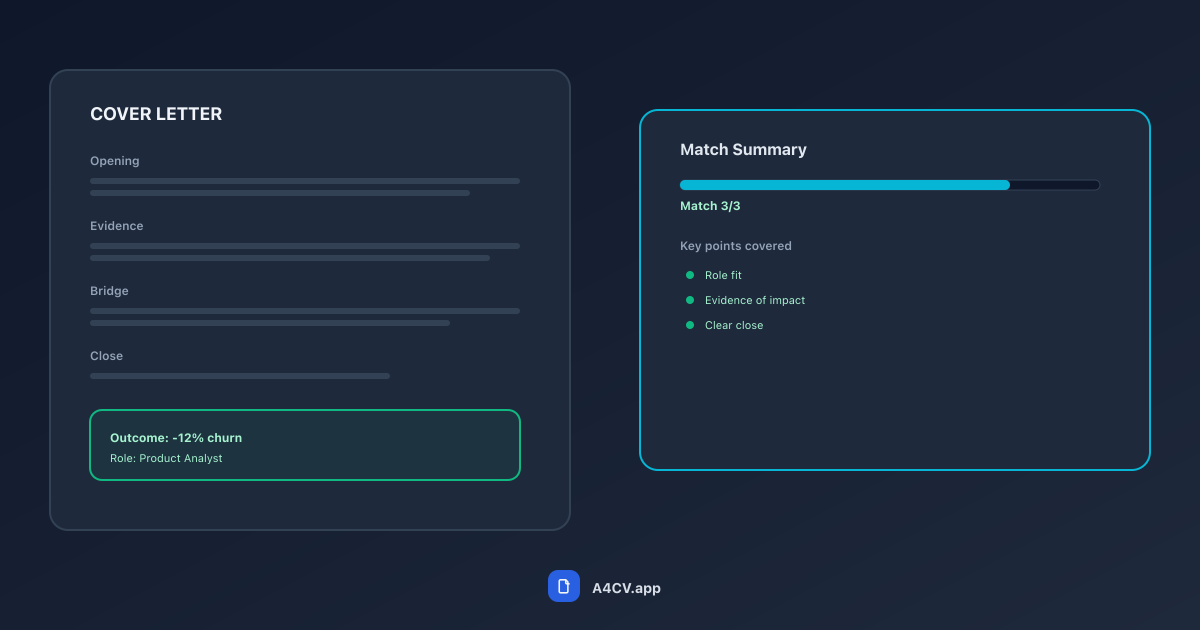
A strong cover letter has four parts: specific opening, evidence, bridge to their needs, and clean close.
What a cover letter actually does
A cover letter should do three things:
- Clarify the role you want and why
- Show that your experience maps to their needs
- Signal that you can communicate clearly
It shouldn't repeat the resume line by line. If it does, it gets skipped.
The structure that consistently works
1) A specific opening
Name the role and the reason you care. One sentence that shows intent beats a generic opener.
2) A tight evidence paragraph
Pick one or two proof points that align with the job. Use outcomes, not duties.
3) A short bridge
Connect your experience to what they're likely hiring for next. This is where you show you understand their goals.
4) A clean close
Thank them, state your interest in next steps, and keep it simple.
Two real examples
Example 1: Career transition
Dear Hiring Manager,

I'm applying for the Product Analyst role because I want to move from customer operations into product. In my current role, I built a weekly churn dashboard that reduced cancellations by 12% by surfacing early warning signals for account managers.

That work showed me I enjoy finding patterns and turning them into product decisions. Your role lists experimentation and retention as core responsibilities, which matches the work I'm already doing in a smaller scope.

I'd welcome the chance to discuss how I can bring that analytical focus to your product team.

Sincerely,
Ariana K.
Example 2: Senior role with scope
Dear Hiring Manager,

I'm applying for the Engineering Manager role to lead a team that scales a high-traffic product. At Streamly, I led a team of 7 engineers and cut incident volume by 35% by redesigning our deployment process and observability standards.

Your posting emphasizes reliability and cross-functional collaboration. That's been the center of my work for the last three years, partnering with product and support to set SLAs and reduce churn.

I'd be glad to walk through my approach to team performance and reliability.

Sincerely,
Jordan T.
Notice what both examples have in common: they're short, they include a specific outcome, and they connect the applicant's past work to the company's needs.
How to tailor without overthinking
Tailoring isn't rewriting from scratch. It's selecting the right two proof points and mirroring the language of the job post.
- Pull 3-5 key phrases from the job description
- Choose one achievement that maps to each
- Use the company's terminology once or twice, not everywhere
If your resume length is tight, the letter should be even tighter. Use the same discipline you'd use for a one-page resume. See One Page vs Two Page Resume: When Length Matters.
Common mistakes
Generic openers. "I'm excited to apply for this position at your company" could fit any job. It tells the reader nothing.
Repeating the resume. Your cover letter should add context, not summarize what they can already see.
Listing skills without outcomes. "I'm proficient in Excel" is weak. "I built forecasting models in Excel that reduced planning errors by 30%" is strong.
Long, unbroken paragraphs. If your letter looks like a wall of text, it won't get read.
Over-explaining gaps. A brief mention is fine. A paragraph of justification raises more questions than it answers.
If you recognize yourself in these, also check Top Resume Mistakes That Kill Your Chances. The same fixes apply.
Best practices that raise response rates
- Keep it to 3-4 short paragraphs
- Show one clear outcome that proves your fit
- Match the company's tone without copying it
- Use plain language and short sentences
- End with a clear ask for a conversation
Cover letters should also match your level. Entry-level letters should prove readiness and project work. Senior letters should show scope and decision-making. See Entry-Level Resume Guide: How to Stand Out with Limited Experience and A Simple Resume Checklist for Senior Roles.
FAQ
Do I need a cover letter in 2026?
If the posting asks for one, yes. If it's optional, a short, tailored letter can still differentiate you - especially for competitive roles.
How long should a cover letter be?
Three to four short paragraphs. If it runs longer than half a page, cut it.
Should I use a template?
Use a structure, not a script. Templates help you format, but the content must be specific.
Can a cover letter hurt me?
Yes, if it's generic or rambling. A weak letter is worse than no letter.
Should I address it to a specific person?
If you can find the hiring manager's name, use it. If not, "Dear Hiring Manager" works fine. Don't spend an hour hunting for a name.
The bottom line
A cover letter isn't a formality - it's your chance to explain fit in your own words. Three paragraphs. One clear outcome. A reason they should call you back.
If it reads like it could only be yours, you've done it right.
Need to build the resume that goes with it? Start with the resume builder or browse templates designed for ATS compatibility.
Want a resume that reads like this article?
Open the builder and polish your resume with a live A4 preview.